1 (a) Explain, with examples, the significance of the value of a good's cross-elasticity of demand in relation to its substitutes and complements. [8]
Cross-elasticity of demand, XED measures the responsiveness of quantity demanded to a change in price of its related good. The formula for XED is the percentage change in quantity demanded of good Y divided by the percentage change in price of good X.
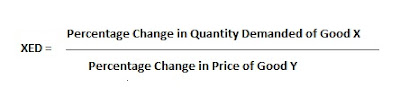
The value of the XED acquired will be a positive value when the quantity demanded of a good is determined in relation to the change in price of its substitute good. This is because of the direct relationship between the price of its substitute good and the quantity demanded of the good. For example, lets take the two famous phone services, DiGi and Maxis. DiGi is a substitute good for Maxis. When the prices of DiGi and Maxis are similar, their quantity demanded will more or less be the same too. Assuming ceteris paribus, DiGi were to decrease their phone plan price, this would be a great factor to attract Maxis' customers over to change to DiGi, resulting a decrease of quantity demanded for Maxis. Similarly, if the price of DiGi increases, the quantity demanded for Maxis might increase too. So, we see that when price of DiGi, which is the substitute good increases, the quantity demanded for Maxis increases too and vice versa. The value of XED will always remain positive.
The value of the XED acquired will be a negative value when the quantity demanded of a good is determined in relation to the change in price of its complement good. This is due to the inverse relationship between the price of its substitute good and the quantity demanded of the good. For example, petrol and cars. Petrol is a complement good to cars. Assuming ceteris paribus, if all the petrol stations were to increase the price of petrol, this will cause petrol to be more unaffordable to some consumers. If they are having difficulty to buy petrol, then they are going to have difficulties in buying cars because cars run on petrol. Therefore, if the price of petrol, which is the complement good increases, the quantity demanded for cars will decrease, and vice versa. The value of XED will always stay negative.
(b) Discuss the usefulness to businesses of a knowledge of price elasticity of demand and income elasticity of demand. [12]
Price elasticity of demand, PED is defined as the responsiveness of the quantity demanded of a good to a change in its price. The formula for PED is the percentage of change in quantity demanded divide by the percentage change in price.
Knowing the price elasticity of demand is important for businesses because it helps to set pricing policies to earn more profits and also revenue. Producers or businessmen should always know the characteristics of their goods so the will charge the price accordingly.
If producers are selling normal goods, they must know that their goods are often elastic. This means when price
falls, the quantity demanded for good X will increase. When the producers or businessmen have knowledge in price elasticity demand, they will know how to
manipulate the price change. They can have attractive promotions in order to attract more customers. For example, shoes are normal goods that are elastic. There is a big increase in quantity demanded whenever there is a decrease in prices of shoes. Consumers who initially couldn't afford shoes, can now afford them. And as for consumers who already owned a pair of shoes can now own more.
As an example, when the prices of shoes is RM 10, the quantity demanded for shoes is 10 pairs. The total revenue for the producers would be RM 10 x 10 = RM 100. But, when the prices of shoes decrease to RM 5, the quantity demanded for shoes is 20 pairs. The total revenue for the producers now would be RM 5 x 20 = RM 200. This proves, when the producers decrease the prices of shoes, the quantity demanded for shoes increases. Thus, producers of elastic normal goods should decrease their prices to have a larger amount in total revenue.
If the producers are selling a normal good, a necessity with no substitute goods, the goods are inelastic. For example, school uniforms are normal goods that are inelastic. When the prices of the school uniforms increase, there may be only a small fall in the quantity demanded for it. This is because it is a must for consumers that have children that are still studying to buy this good. They have no other choices.
As an example, if the prices of school uniforms are at RM 10, the quantity demanded for that good is 10. The total revenue is RM 10 x 10 = RM 100. When the prices of the school uniforms increased to RM 15, the quantity demanded for that good decreases to 8. The total revenue is RM 15 x 8 = RM 120. There is a small decrease in quantity demanded when there is an increase in prices of the school uniforms that will still allow the producers to earn more profit. Thus, the producers should increase their prices of inelastic normal goods in order to increase their total revenue.
Income elasticity of demand, YED measures the responsiveness of demand to a change in income. The formula for YED is the percentage change in quantity demanded divided by the percentage change in income.
Producers can refer to the YED to decide whether they should expand their business or to cut back on certain expenses. When there is economic growth, there may be an increase in wages which will lead to an increase in one's income and because of that, consumers can afford better. For example, consumers who were driving Perodua can now afford Audi. They might buy an Audi compared to Perodua, which is now an inferior good. There will be an increase in quantity demanded for Audi and a decrease for Perodua.
During this period, the producers of Audi will know that this is a good time to increase their production as there are more demand from consumers. On the other hand, the producers of Perodua should either cut back on production or have more promotions or even launch a new car model to attract back their customers. So, from this, we know that normal, luxury goods should increase their production when the economy is doing well while the inferior goods should most probably cut back on production.
During economy downfall, there may be a fall in consumers' income. This means they will cut back on buying luxury products as they are not necessary. For example, consumers who wanted to buy iPhones may just settle for Sony Ericsson instead. This will be a good time for producers of Sony Ericsson to increase their production and as for iPhones, they should cut down on production or even promote a cheaper, better phone plans.
Whatever it is, some consumers, like really rich consumers are not affected by the rise or downfall of the economy at all. They might not be cutting back on spending and splurging on luxury goods. Because of this, producers of luxury goods may not need to cut back on their production.
Knowing well in price
elasticity demand and income price elasticity demand is absolutely
important in the business field. Every consumer has different demands and requests. The producers must be smart enough to get hold and know their target on which group of consumers they are aiming for. The producers have to know the
way to manipulate the consumers' needs, wants and demands in order to
increase their total revenue and profit.


